

Q2 2026 Review | Market Update
ARTICLE AUTHOR

SHARE:
The second quarter of 2026 was defined by a reversal in investor concerns surrounding the conflict with Iran. The S&P 500 began the quarter near its low for the year before recovering to new all-time highs.¹ Oil prices followed a similar path, rising toward $100 per barrel during the conflict, ending the quarter near $70, roughly where they were before the conflict began.²
AI-related enthusiasm remains a major market driver, but leadership has shifted. The Magnificent 7, which led markets in recent years, have posted negative returns through the first half of 2026.³ In contrast, memory and semiconductor companies have become the primary beneficiaries, with the Philadelphia Semiconductor Index gaining roughly 100% year-to-date. Continued uncertainty surrounding inflation and new Federal Reserve Chair Kevin Warsh briefly pushed the 10-year Treasury yield above 4.5%.
As we enter the heart of the midterm election season, markets may experience the elevated volatility that has historically accompanied election uncertainty (Figure 1).
Market narratives continue to change quickly, making it easy for investors to become distracted by short-term events. We believe the best approach remains maintaining a long-term investment plan, avoiding the temptation to chase popular themes, and taking advantage of attractive opportunities when market volatility creates them. At Caliber, we continue making disciplined adjustments on the margin when valuations and fundamentals warrant.


Iran & Inflation
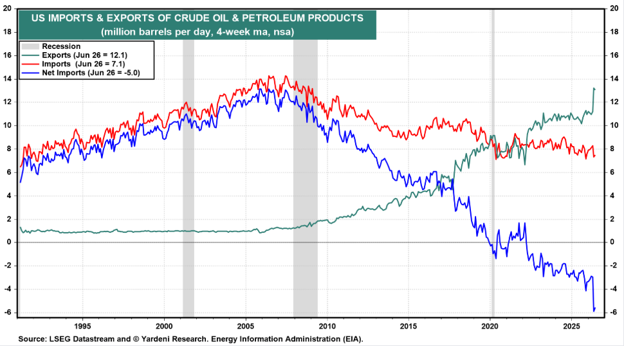
The conflict involving Iran continued through the end of Q2, but markets appear to have largely moved past the uncertainty. The clearest sign has been the stabilization of oil prices and global energy markets. U.S. petroleum exports increased from approximately 11 million barrels per day before the conflict to more than 13 million barrels per day, helping offset supply disruptions caused by the Strait of Hormuz closures (Figure 2). Additional production expected later this year should further support supply.⁶
From an economic standpoint, higher energy prices have benefited U.S. producers while temporarily contributing to higher inflation readings.⁷ As energy markets normalize, inflation pressures should ease, reducing concerns about additional Fed tightening. Gasoline prices remain elevated but may decline after the summer driving season, providing some relief to consumers ahead of the holidays. Overall, the U.S. economy appears to have several supportive factors heading into the second half of the year, independent of the ongoing AI-driven investment boom.
Market Euphoria & Leverage
Investor enthusiasm surrounding AI has continued in 2026, but market leadership has shifted. The Magnificent 7, which drove returns in 2024 and 2025, generated a -2.5% return during the first half of the year, while the Philadelphia Semiconductor Index gained 113%.³⁻⁴ Much of this strength has been driven by a sharp increase in DRAM prices, as demand from data center construction has outpaced available supply, leading to significantly higher earnings for memory producers.
History suggests these conditions may not be permanent. Semiconductor markets have traditionally been cyclical, and elevated profit margins often lead to increased production that eventually restores supply-demand balance. At the same time, investor enthusiasm has been amplified by the growing use of leveraged ETFs and short-dated options (Figure 3), increasing the potential for both gains and losses.
While the recent returns have been impressive, the combination of elevated leverage and a historically cyclical industry could create future volatility. Maintaining a disciplined, diversified investment approach remains prudent, even when concentrated areas of the market are generating outsized gains.

Midterms
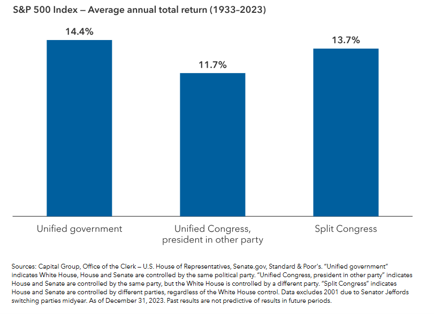
The 2026 midterm elections will take center stage this quarter. Prediction markets currently favor Democrats gaining control of the House while Republicans retain the Senate, resulting in a divided federal government.⁸ Historically, the party holding the White House tends to lose congressional seats, making this a plausible outcome.
Election seasons often bring heightened political rhetoric and increased market volatility (Figure 1). While headlines can create uncertainty, history shows that markets have generated positive long-term returns across a wide range of election outcomes (Figure 4). In many cases, markets respond more to economic and company fundamentals than political results.
Although volatility may increase as Election Day approaches, markets have historically performed well after uncertainty is resolved. This reinforces a broader investment principle: markets tend to reward clarity, regardless of the outcome.
Kevin Warsh at the Fed
June marked Kevin Warsh's first Federal Reserve meeting as Chair. While he signaled several potential changes to the institution, the Fed left interest rates unchanged. Markets currently expect one or two rate hikes by year-end, but easing inflation pressures from the recent energy shock could result in a less restrictive path than currently anticipated.⁹
Beyond interest rates, Warsh's proposed reforms may be constructive for markets. He has expressed support for reducing the Fed's reliance on forward guidance and gradually normalizing the balance sheet. A smaller, shorter-duration balance sheet could reduce market distortions, strengthen price discovery, and help limit future inflationary pressures.
Long-term Treasury yields are primarily driven by expectations for inflation and economic growth. Current bond yields may reflect a more pessimistic inflation outlook than could ultimately prove warranted, creating attractive opportunities during periods of temporary rate spikes. We continue to monitor these opportunities when evaluating fixed-income allocations.
Best Regards,Jimmy Kelley
Chief Investment Officer
Caliber Wealth Management
- https://www.spglobal.com/spdji/en/indices/equity/sp-500/#overview
- https://fred.stlouisfed.org/series/DCOILWTICO
- https://www.morningstar.com/etfs/bats/mags/performance
- https://www.morningstar.com/etfs/xnas/soxx/performance
- https://fred.stlouisfed.org/series/DGS10
- https://www.eia.gov/totalenergy/data/monthly/pdf/sec5_3.pdf
- https://fred.stlouisfed.org/series/CPIAUCSL
- https://polymarket.com/predictions/midterms
- https://www.cmegroup.com/markets/interest-rates/cme-fedwatch-tool.html


